Speakers



Moderators


Link to recording of M3 Webinar Jan 2026
Industry recommendations for validation of Bio-fluorescent Particle Counting
A special Webinar Event Presented by Modern Microbial Methods
Program Overview
· Introduction to Bio-fluorescent particle counting technology (BFPC)
· Description of the validation process
· Recommendations for the validation pathway of BFPC technology
· Specific recommendations for primary and secondary validation
Bio-Fluorescent Particle Counting (BFPC) provides real-time microbial monitoring for water and air, but the validation of this non-growth-based method can be a challenge. To help guide the implementation of BFPC in GMP applications, this webinar will review the validation recommendations recently published by the Modern Microbial Methods (M3) industry working group in the PDA Journal.
In this webinar, several authors of recently published validation recommendations for Bio-flourescent Particle Counting (BFPC) technology will describe the validation process and its scientific justification in the context of GMP applications. The use of BFPC technologies has been of interest to the pharmaceutical industry for several years. These technologies are a non-growth-based method that use optical signatures to categorize detected particles as biologic or non-biologic. As a result, the systems report in a unit of measure not equivalent to the colony-forming unit. Although guidance on the validation of alternative microbial methods is available, significant challenges exist when validating non-growth based alternative methods compared to the growth-based compendial method. This webinar, from collaborators in the Modern Microbial Methods (M3) industry working group, will provide thoughts and recommendations on a method validation pathway for BFPC. Technology specific recommendations on the primary and secondary validation will be discussed with considerations on the applicability of individual validation parameters and associated acceptance criteria for this emerging technology that does not rely on the colony-forming unit.
Speakers and Moderators
Patrick Hutchins, PhD (Speaker)
TSI
Patrick is a Global Product Manager at TSI where he supports and develops TSI’s line of pharmaceutical cleanroom products including the BioTrak Bio-fluorescent Particle Counter (BFPC). Prior to joining TSI, Patrick was in academia, first earning a PhD in Pharmacology at the University of Colorado and later developing novel particle instruments and tests for cardiovascular disease at the University of Washington. Patrick has been at TSI working with BFPC technology for 10 years.
Cynthia Martindale (Speaker)
Applied Rapid Microbiology Specialists, Ltd.
Cynthia Martindale is an independent consultant with Applied Rapid Microbiology Specialists and has worked in the field of microbiology for over 30 years. She has hands-on experience with evaluating and validating bio-fluorescent particle counters and is a member of several industry groups aimed at implementing modern microbiological methods. Prior to consulting, Cynthia worked in the industry for over 20 years, including positions as the Head of Quality Control at the Amgen Colorado Manufacturing site and the Corporate Lead for Rapid Microbiology.
Kim Perkins, PhD (Speaker)
Mettler-Toledo Thornton
Kim Perkins obtained his PhD from Arizona State University studying the molecular mechanisms of vaccinia virus pathogenesis. Following his postdoctoral fellowship at the Mayo Clinic, where he studied the mechanisms of integrin-ligand binding, he moved on to play key roles in the field of both drug and device development. After a position managing the quality team at a pharmaceutical manufacturing facility, he moved on to Mettler-Toledo Thornton, where he is leading the microbiology team in the development of a Real-Time Online Water Bioburden Analyzer.
Allison Scott (Moderator)
BWT Pharma & Biotech Inc
Allison is Principal Scientist at BWT Pharma and Biotech Inc. She has evaluated modern microbial methods including bio-fluorescent particle counters for over sixteen years, focusing on diverse technology applications in air and water monitoring and supporting end user implementation. Allison facilitates the Steering Committee and one of the sub-team for the Modern Microbial Methods collaboration.
Jim Cannon (Moderator)
Mettler-Toledo Thornton
Jim Cannon is Head of OEM and Markets at Mettler-Toledo. After receiving a
B.S. in Biology, he continued with graduate degrees in Microbiology and followed by a graduate degree in Biophysics, and an MBA in Marketing and International Management. Mr. Cannon has over 40 years of experience managing, designing and developing ultrapure water treatment and technology. He has been involved in the continued development and the commercialization of alternative online microbial detection technology and coauthor of several technical papers to demonstrate validation and equivalency. Jim is a member of M3steering committee and two sub-teams.

-
M3 Webinar
Program Overview
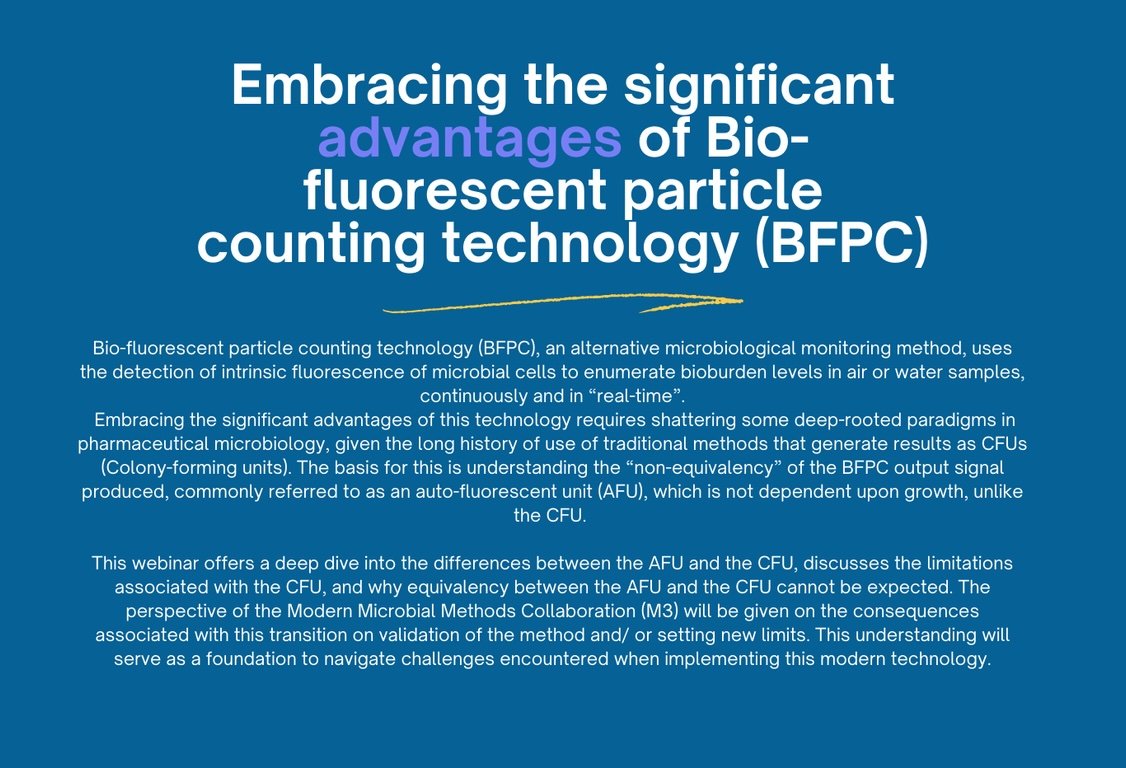
Introduction to Bio-fluorescent particle counting technology (BFPC).
Comparison between traditional CFUs and AFUs.
Limitations associated with CFUs and why equivalency cannot be expected.
Discussion on the consequences associated with this transition on validation of the method and/or setting new limits.
Link to Webinar recording
https://1drv.ms/f/c/61a8716ac1ec3ca8/EnFcesFN8ptErWadc03pnUoB_9D0P0uuU91RmzNEfr8-9Q?e=tTMxQS
Link to the Questions and Answers from the M3 Webinar.
https://1drv.ms/w/c/61a8716ac1ec3ca8/ETCbtiIYPaBEjLxr4zcZg08BMkUAhToc-EFWvYz2r3qWXg?e=MuwhLQ